On this page
In the 1950s, a psychologist named Curt Richter ran a series of experiments that, on the surface, seem almost cruel in their simplicity. He placed rats into containers of water they couldn’t escape from and watched how long they swam. Left alone, they lasted about fifteen minutes before giving up. Exhaustion set in quickly. The outcome appeared predictable.
What made the experiment strange was what happened next. Richter removed some of the rats just before they gave up, let them rest briefly, and then placed them back into the same inescapable water. This time, they swam for hours. Not because they had become physically stronger, and not because they had learned some clever new strategy. The environment hadn’t changed. The only difference was expectation. They had learned, once, that rescue was possible.
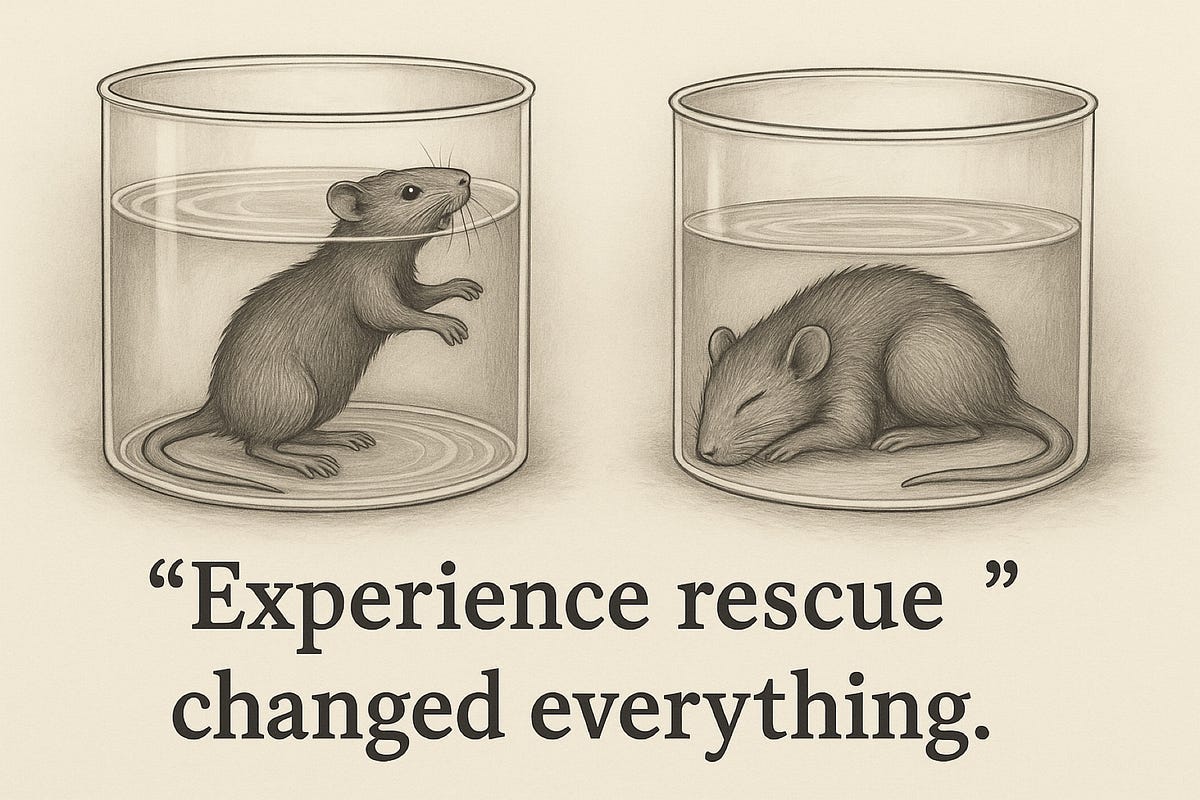
The distance between fifteen minutes and sixty hours wasn’t stamina. It was belief. A quiet, internal update about what the future might contain completely changed how long the present could be endured.
For a long time, that idea stayed abstract to me. Interesting, but distant. A neat psychological result. It wasn’t until this year that it stopped feeling theoretical.
On paper, 2025 reads like progress. Eight months at Shopify. Research papers accepted. Travel. School milestones. Graduate applications sent off. A sequence of roles and outputs that suggest steady forward motion. If you were skimming, you might conclude it was a good year. And in many ways, it was.
But living inside it felt different. There were long stretches where nothing was obviously wrong, yet everything felt heavier than it should have. Periods where effort didn’t translate into reassurance. Where I was doing all the things I had been told were worth doing and still felt oddly suspended, unsure whether the work in front of me was accumulating into something coherent or just keeping me afloat.
What I eventually realized is that the hardest moments this year weren’t about workload or failure. They were about uncertainty. About not knowing whether what I was swimming toward actually had an edge. Whether there was a wall to reach, or just more water. When belief in eventual resolution weakens, even manageable effort starts to feel endless.
And then, gradually, something shifted. Not because the work became easier, but because my relationship to it changed. I began to see continuity where before there had only been fragments. Between research and product. Between effort and outcome. Between who I was becoming and what I was building. The uncertainty didn’t disappear, but it stopped feeling infinite. And with that came endurance. A quieter patience. A steadier kind of momentum.
Looking back, that’s what defined 2025 for me. Not achievement, and not productivity. But learning how much belief shapes what you’re capable of sustaining. How endurance isn’t just a function of effort, but of expectation. Progress, I learned, isn’t about how hard you can swim. It’s about whether you believe the water has an edge at all.
What follows is a reflection on the moments that restored that belief for me—the work, the people, the failures, and the recalibrations that made this year feel less like flailing and more like movement. Not as a highlight reel, but as a record of the lessons that only became visible in hindsight. To recap, here is what I was up to during 2025:
Interned at Shopify as a Machine Learning Engineer on the Foundation Models team for 8 months
Wrapped up my internship as a data scientist at the federal government
Published 3 research papers in a peer reviewed journal, you can find them here
Worked with IBM and RedHat on a research project understanding the impacts of finetuning and sythentically generated data
Presented my work at AI tinkerers at the Shopify office in November!
Continued presidency at UofT AI — hosted Conference X 2025, started Toronto AI review, & hosted numerous events throughout the year
Started new substack publication — on the more reflective and philosophical stuff in life
Travelled a bunch
Worked as a Research Scientist at the Vector Institute
Continued working as a MLE at Fallyx
Worked at Acadia University to develop an application for the SMILE program
Worked on a few research projects with my professors spanning from Generative Engine Optimization to Querying Graph DBs to designing better clarifying AI agents & more
Seen as bullet points, this year looks almost clean. Linear, even. A sequence of roles, outputs, and milestones that suggest momentum in a straightforward direction. But that’s not how it felt from the inside. The list captures what happened, not what it asked of me. It doesn’t show the weeks where progress felt invisible, the moments where confidence lagged behind evidence, or the recalibrations that happened when certain paths stopped feeling as solid as they looked.
What 2025 taught me wasn’t how to do more. It taught me how to stay with things longer. How to tolerate ambiguity without immediately trying to escape it. How to keep working when belief wavers, and how much it matters when it comes back. Many of the most important shifts this year didn’t show up as achievements at all, matter of fact, they showed up as changes in how I related to uncertainty, how I chose what to commit to, and how I measured whether something was worth continuing.
Looking back, the year wasn’t about pushing harder. It was about discernment. About learning which efforts deserved patience, and which ones only looked convincing from the outside. Endurance, I found, matters most when it’s pointed in the right direction. Otherwise, it just becomes motion without arrival.
The reflections that follow are my attempt to name those realizations while they’re still close enough to feel honest. Not as prescriptions, and not as conclusions, but as markers left along the way. The subtle shifts that didn’t announce themselves at the time, but that, in retrospect, shaped the year more than any single achievement did.
hope is a skill, not a feeling.
(Why endurance depends more on expectation than energy)
For most of this year, I assumed that what I was feeling was fatigue.
That explanation felt especially plausible in the context of research. Long hours, slow progress, weeks spent circling the same questions. Anyone who’s done research knows the texture of that work: the patience it demands, the way effort often outpaces visible results. Fatigue seemed like the obvious culprit.
But over time, that explanation stopped holding up. Rest helped my body, but it didn’t restore momentum. Time away from the work made me less tense, but not more oriented. When I returned, the same heaviness waited for me; not because the work was too hard, but because something more fundamental was missing.
What I eventually noticed was that the hardest stretches in research weren’t the ones where I worked the most. They were the ones where I couldn’t tell whether I was getting closer to anything at all.

Research has a particular way of exposing this. You can spend days chasing down a lead that dissolves under scrutiny. You can refine an idea only to realize it collapses under a slightly different framing. You can make real progress in understanding without producing anything that looks like progress from the outside. In those moments, effort continues, but reassurance doesn’t.
There is a difference between being tired and being uncertain. Tiredness is local and temporary. Uncertainty, when it lingers, reshapes how effort feels. When you don’t know whether a problem is tractable, or whether your approach has any chance of resolving into insight, every additional hour carries an implicit question mark.
This was the real drain this year. Not the workload, but the periods where I was swimming without knowing whether the problem had edges. Where it wasn’t clear whether persistence would reveal structure or simply prolong confusion. Research doesn’t reward effort uniformly; it rewards effort in directions that eventually fold back on themselves. When you can’t tell which kind you’re doing, endurance becomes fragile.
What changed later in the year wasn’t that the work became easier. It became more demanding, if anything. But my relationship to the uncertainty shifted. I began to sense when confusion was productive rather than terminal. I learned to recognize the difference between a problem that was resisting me and one that was simply still forming.
That distinction mattered more than any increase in discipline.
Once I had a reason to believe that the uncertainty would eventually resolve i.e that the problem space wasn’t infinite, that there were constraints I hadn’t yet discovered, I could stay with it. The effort stopped feeling like thrashing and started feeling like excavation. Patience followed naturally, not as a moral virtue, but as a practical response to belief.
In hindsight, the increase in stamina I experienced had little to do with becoming tougher. It came from regaining a sense that the work was converging, even if slowly. That expectation, fragile as it was, changed everything. When you believe a problem has structure, you’re willing to endure its ambiguity.
In research especially, hope is not a feeling you wait for. It’s a skill you develop by learning which kinds of uncertainty are worth staying inside. And once that skill is in place, endurance stops being the bottleneck.
And once endurance is no longer the bottleneck, a different question takes its place.
Not can I keep going—but where should I?
clarify is often a lagging indicator, not a prerequisite.
For a long time, I believed clarity was something you were supposed to have before you committed. That if you thought hard enough, researched enough, waited long enough, the fog would lift and the next step would present itself cleanly. Only then would it make sense to move.
This year dismantled that idea almost completely.
What I kept running into, across research, product work, and grad school decisions, was the same pattern: clarity didn’t arrive at the beginning of the work. It arrived because of the work. Often late. Sometimes uncomfortably late.
In research, this was impossible to ignore. There were projects where, in the first few weeks, everything felt vague in a way that was hard to articulate. The questions sounded reasonable, the methods were defensible, but the center of gravity wasn’t obvious. I kept wanting to “figure it out” before going deeper, to resolve the ambiguity upfront so the work could proceed cleanly. That instinct was wrong. The projects only started to make sense after sustained contact; after reading far more than felt efficient, after trying approaches that didn’t pan out, after writing things down and realizing how little I actually understood. The signal didn’t precede the effort. The effort generated the signal.

The same thing showed up at Shopify. Early on, I wanted to understand the problem space fully before touching anything. I wanted the architecture to feel obvious, the tradeoffs to be neatly laid out, the goal to be crisply defined. But at scale, especially when working with foundational models, that level of upfront clarity is mostly an illusion. The real constraints only surface once something is built, once it runs, once it fails in ways you didn’t predict. Shipping wasn’t the final step after understanding — it was how understanding began. The system had to respond before the problem revealed its true shape.
Grad school was no different. For months, uncertainty felt like a reason to hesitate. I treated not knowing the outcome as a signal that I should wait, refine, prepare more. In reality, submitting the applications was what collapsed the uncertainty. Not because the answers arrived immediately, but because the act of committing transformed a vague future into a bounded one. Only after sending things off did my thinking sharpen. Only then did certain preferences, priorities, and tradeoffs become legible.
What ties all of this together is a simple but uncomfortable truth: clarity is often a lagging indicator. It trails commitment. It trails exposure. It trails time spent inside a system rather than thinking about it from the outside.
This is non-intuitive because we’re trained to treat clarity as a prerequisite for action. We’re taught that good decisions come from confidence, from knowing what you’re doing, from having a plan that makes sense end to end. But in complex environments, waiting for that kind of certainty is a form of avoidance. Not because you’re lazy or afraid, but because the system itself hasn’t had a chance to give you information yet.
Action creates data. Data refines direction. Direction produces clarity. The ordering matters.
This year forced me to stop asking, “Do I understand this well enough to commit?” and start asking, “What would I learn if I stayed with this longer?” That shift didn’t eliminate uncertainty, but it changed my relationship to it. Confusion stopped being a red flag and started becoming a signal that I was early in the process, not failing it.
Clarity didn’t show up first. It showed up last. And almost every meaningful thing I worked on this year followed that same sequence.
what it means to contextualize competence.
For a long time, I thought competency was mostly about accumulation.
More skills. More credentials. More proof that I belonged in the room. If I kept adding things to the stack (courses, papers, internships, projects), eventually it would become undeniable. Competence, I assumed, was something you built in isolation and then carried with you, like a passport that should work anywhere.
This year broke that illusion.
At Shopify, I was working on foundational ML systems that had to survive contact with reality. Not just demos or clever ideas, but models that would be depended on, extended, and operated by people who didn’t have the full context in their heads. In research, I was doing almost the opposite: pushing into questions where the answer wasn’t known yet, where ambiguity was part of the job, and where progress often looked like circling the same idea for weeks before anything clicked.
In both places, I was “competent” in the narrow sense. I could write code. I could read papers. I could reason about models. But what mattered most, over and over again, wasn’t raw ability. It was fit.
Competence turned out to be highly local.
In product, being competent meant making yourself legible. Writing things so other people could pick them up. Choosing solutions that traded a bit of theoretical elegance for robustness. Anticipating how something would fail at scale, not just how it would work in ideal conditions. You could be technically strong and still be a liability if your work increased cognitive load for everyone else.
In research, competence meant almost the opposite. You were rewarded for sitting with confusion, for pushing past the point where things felt obvious, for resisting the urge to prematurely tidy up an idea. Speed could actually work against you. The most valuable contributions often came from people who were willing to look slow, to ask questions that felt embarrassingly basic, to keep worrying at something long after others had moved on.
What surprised me is how easy it was to feel incompetent in both settings for the same underlying reason: misalignment. I wasn’t failing because I lacked ability. I was failing when I optimized for the wrong signals.
There were moments this year where I was clearly doing good work, but still felt off. And there were moments where I felt deeply competent, even though I didn’t have much to show for it yet. The difference wasn’t output. It was whether my effort matched what the environment actually needed.
That reframed competence for me entirely.
It’s not a fixed trait you earn once and then deploy everywhere. It’s a relationship between you and a context. Between what you can do and what the system rewards. When those line up, progress feels strangely calm. When they don’t, no amount of grinding fixes the underlying tension.
This also explained a quieter realization: why some people seem to move effortlessly through certain environments while struggling in others. It’s not that they’re universally more capable. It’s that they’ve learned to read the game they’re in. They understand the incentives, the failure modes, the unspoken expectations. Their competence is contextual, not abstract.
Once I saw this, my relationship to growth changed. I stopped asking, “How do I become more impressive?” and started asking, “What does being useful look like here?” In product, that meant prioritizing reliability over novelty. In research, it meant protecting time for depth even when it looked unproductive from the outside.
Competence, I learned, isn’t about being the best version of yourself in the abstract. It’s about becoming the right version of yourself for the problem in front of you.
And once that clicked, a lot of the quiet friction I’d been carrying finally made sense.
the hardest part of growth is letting old skills become insufficient.
Being in my final semester of undergrad has put me in a strange mental space. I’m not done yet, but I’m close enough to the edge that I can see which parts of me were built for this environment, and which ones are starting to feel brittle.
For most of university, progress was simple. If something wasn’t working, the fix was usually effort. Study more. Grind harder. Take on more. Optimize for speed and output. That mindset carried me surprisingly far, because school is designed to reward exactly that: responsiveness, consistency, and the ability to perform under constraints that are clearly defined.
But somewhere in the last year, that playbook started producing diminishing returns.
What’s been unsettling is realizing that the skills I relied on most, the ones that made me feel competent, are no longer sufficient on their own. Working harder doesn’t automatically translate into better outcomes. Moving faster doesn’t always mean moving forward. Being “on top of things” can still coexist with a quiet sense that something isn’t quite right.
The instinct, when this happens, is to double down. To tighten your grip on what’s always worked. But this semester has been teaching me the opposite lesson: growth at this stage isn’t additive. It’s subtractive.
Letting go of old strategies is harder than learning new ones because those strategies are tied to identity. They’re how you learned to feel capable. Efficient. Worth listening to. When they stop working, it doesn’t just create friction with the work; it creates friction with who you think you are.
I’ve had to sit with that discomfort more than I expected. Moments where I caught myself reaching for familiar patterns ie doing more, saying yes, trying to be impressive, only to realize they were misaligned with what I actually needed. Not more intensity, but more precision. Not more motion, but more discernment. Not more validation, but more honesty about what I don’t yet understand.
Being in this final semester has made one thing clear: the transition out of undergrad isn’t about leveling up the same character with better stats. It’s about realizing that the game itself is changing. And the traits that carried you through the early levels won’t carry you indefinitely.
The hardest part isn’t learning what comes next. It’s accepting that some of what got you here has to be left behind—even before you know what replaces it.
living without the narration.
What I keep coming back to, when I look at this year as a whole, is how much of it only made sense once I stopped trying to narrate it while I was inside it.
For a long time, I had an impulse to explain things to myself as they were happening. To frame every decision, every commitment, every stretch of uncertainty as part of a story that was moving somewhere coherent. I thought that was self-awareness. I thought that was control. But what it often did was pull me one step away from the experience itself. I was observing my life more than I was inhabiting it.
This year quietly dismantled that habit.
There were long periods where I didn’t have a clean explanation for what I was doing or why certain things felt heavier than they looked from the outside. Not because something was wrong, but because I was in the middle of it. And the middle is inherently resistant to interpretation. It doesn’t offer clean feedback. It doesn’t tell you which parts matter yet.

What changed wasn’t that I figured everything out. It’s that I stopped requiring myself to. I learned how to stay with things without immediately turning them into meaning. How to let work be work, uncertainty be uncertainty, and progress remain unlabelled for longer than was comfortable. I learned that a lot of clarity arrives late, and that trying to pull it forward often distorts it.
Looking back now, the year doesn’t feel like a sequence of achievements or even lessons. It feels more like a reorientation of attention. Away from how things looked, and toward how they felt to live inside. Away from explaining myself to an imaginary audience, and toward listening for what actually had weight when no one was watching.
What surprised me most is how stabilizing that turned out to be. Not dramatic. Not euphoric. Just steadier. The kind of steadiness that comes from not constantly asking whether you’re doing life “correctly,” and instead asking whether you’re present enough to notice what’s actually happening.
If there’s a throughline here, it’s not ambition or discipline or endurance. It’s contact. With the work. With the uncertainty. With the people who made the year feel real. With the parts of myself that didn’t need to be optimized, just acknowledged.
This year didn’t give me answers so much as it gave me access. To my own attention. To my own judgment. To a quieter sense of what feels worth staying with.
And that feels like a good place to end.
If you enjoyed this read, consider subscribing :)