On this page
hey there 👋
hey, I’m Dev, and if you’re new to my bi-monthly newsletter, welcome! My bi-monthly newsletter is where I recap what’s been going on in my life and share some thoughts and reflections from the last couple months. Allow me to introduce myself, I’m currently a Machine Learning researcher, working in Medical Imaging x AI under Dr. Tyrrell; looking to integrate Artificial Intelligence into a clinical setting to improve the diagnosis process. Over the past couple of months, I have had the opportunity to close a few significant chapters of my life while simultaneously embarking on some exciting new adventures.
I successfully completed my first year of university, started working on a research project at a lab, and have had the chance to work closely with a start up to implement machine learning models.
As I’ve made progress, I’ve walked away with some important life lessons on the way as well, these experiences have taught me a lot, and I'm excited to share some of those insights with you. Let’s get into the thick of what I’ve been up to this month, hope you enjoy the newsletter!
finding balance ⚖️; reflecting on my first year of university
I closed one of the biggest chapters of my life this month; my freshman year. I’d be lying to you if I said my freshman year was smooth sailing from day one. It was a roller coaster ride of ups and downs, filled with new experiences, friendships, and a plethora of academic and personal challenges. Looking back, I can see how much I've grown and learned from those experiences. In hindsight, the hurdles and obstacles that I faced were not only inevitable but necessary for my growth.
However, out of all those challenges, one thing that I can proudly say is that I’ve finally found the right balance in my life right now. Balance takes shape in everyone's life in different forms, but it's also an ever-changing and evolving concept in yours. My definition of balance right now is much different from what I may of thought 6 months ago. When I started my freshman year, I had this preconceived notion of what balance meant to me. I thought that it meant dedicating equal amounts of time and effort to every aspect of my life, from academics to social life and personal growth. However, this preconceived notion led me to be overwhelmed during certain moments as it was not a realistic or sustainable approach to balance. It wasn't until I experienced these moments of overwhelm that I realized balance is not about perfect distribution, but rather about finding a sustainable rhythm that worked for me.
My journey of finding the right balance was truly internalized during those weird moments of transition between really busy periods and lulls in activity. During those transitions, I had to learn to adapt and adjust my routine accordingly. Sometimes, that meant prioritizing my academic work over my social life or making time for self-care even when my schedule seemed overwhelming. Personally, I’m a person who loves time blocking and sectioning off my days to ensure I get everything that I need to get done for the day.
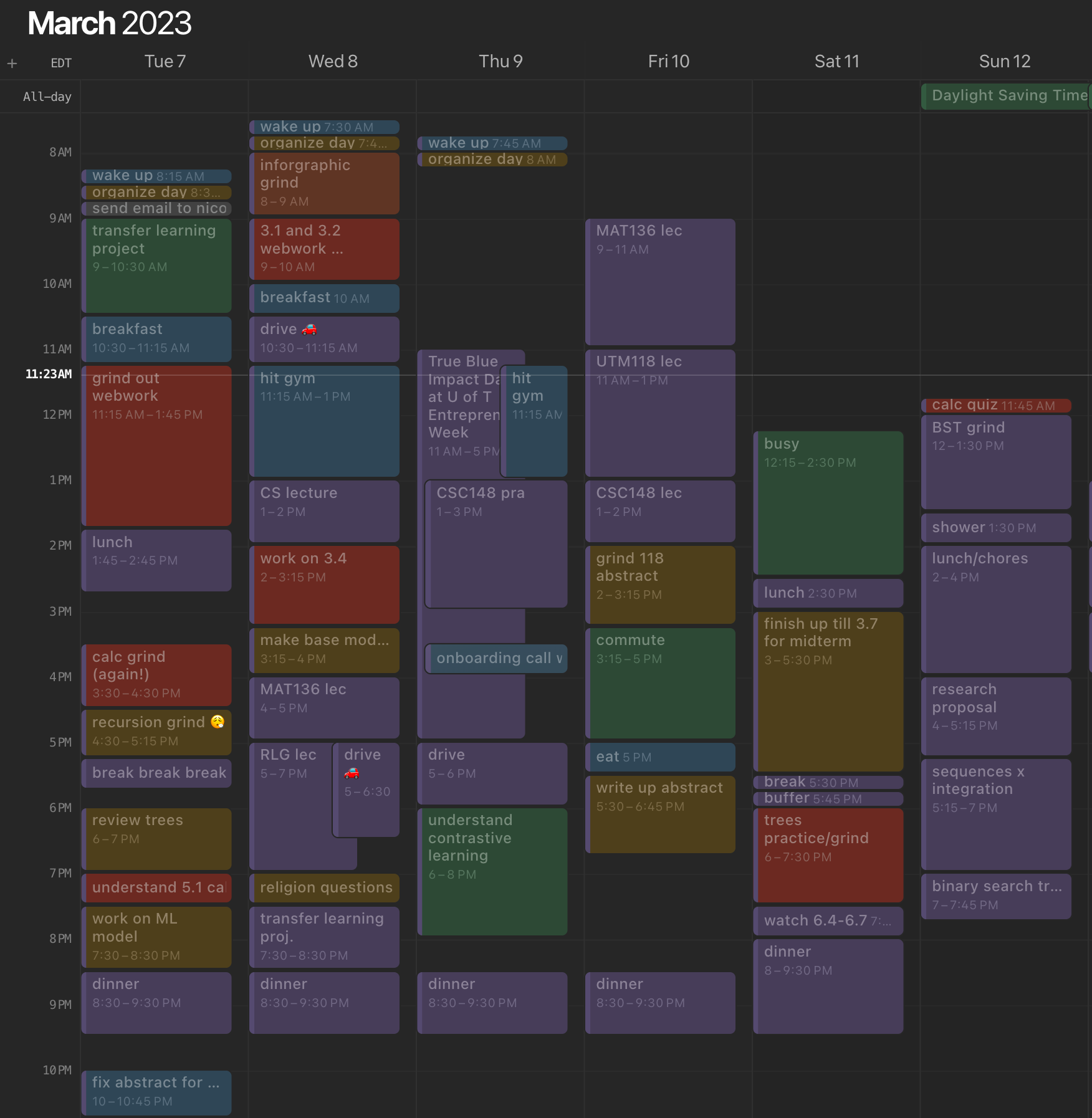
However, I also learned that it's important to allow for some flexibility in my schedule and to be willing to adjust when unexpected things come up. There were some days where I would get frustrated because I was unable to get everything done and stick to my rigid schedule. But, I realized that it's okay to not always follow a plan, and sometimes, being able to adapt to change is a crucial aspect of balance. Through this, I discovered that balance isn't static; it's constantly evolving and changing with each new experience and challenge. What may have worked for me at the beginning of the year may not have been sustainable by the end of it. For me, finding balance was about prioritizing what was truly important in my life and making adjustments as needed.
If there’s one thing that I took away from first year, it’s that the pursuit of balance can often feel like a delicate dance, where one misstep can throw everything off balance. However, it’s essential to embrace the ebb and flow of life, to acknowledge that there will be moments of chaos and calm, moments of abundance and scarcity, moments of joy and sadness, and moments of success and failure. Finding balance requires embracing both the light and dark aspects of life, acknowledging that both are equally important in shaping who we are and what we become.
Overall, my freshman year was a rollercoaster ride that allowed me to learn a great deal about myself and what I am capable of. I am grateful for the experiences, friendships, and challenges that I faced, as they all contributed to my growth and development. While I am grateful for what I have achieved so far, all these systems aren’t built overnight, and I am now beginning to understand that the process of growth and development is a continuous journey. Looking forward to my sophomore year now! :)
researching at a ML lab 🔬
For the past 8 months, I’ve been a part of a Machine Learning x Medical Imaging lab run by Dr. Pascal Tyrrell at the University of Toronto. Recently, I’ve had the opportunity to start a research project and this experience has been both challenging and rewarding, allowing me to gain a deeper understanding of the intersection between machine learning and healthcare. Over the course of the past 2 months, I’ve been researching into creating an ultrasound model to downstream tasks for knee ultrasounds. The overarching problem is that ultrasounds are very diverse and heterogenous and it’s often difficult to diagnose accurately. Moreover, ultrasound imaging is highly dependent on the expertise of the technician performing the exam, which can lead to variability in results.
My approach to this problem was to use a self-supervision technique for feature extraction and disease diagnosis. I’m still in the midst of this research, but I’ve been looking into contrastive learning and potentially leveraging that for this project. The main idea of Contrastive Learning is that it trains the model to differentiate between similar and dissimilar pairs of images by mapping them to a shared latent space.
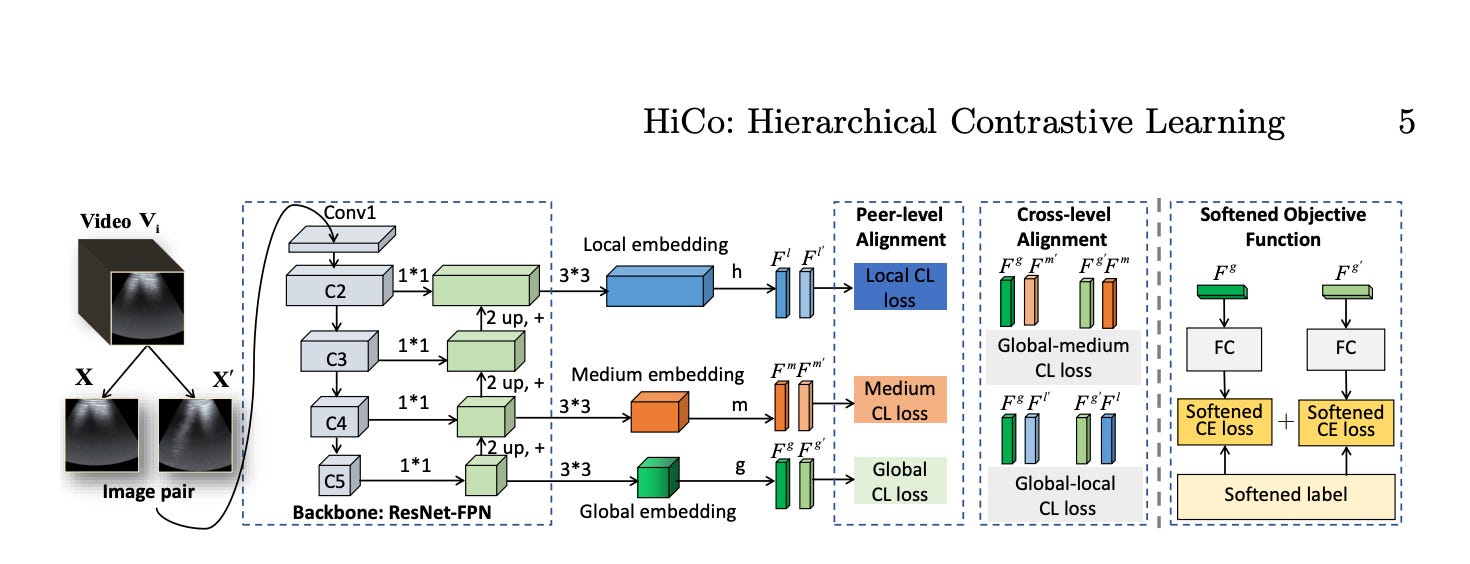
This can be useful for creating representations of ultrasound images that capture the underlying features of the knee joint, allowing for more accurate diagnosis of different pathologies. I’ve been basing my research off this paper that uses a similar approach, but for fetal ultrasound.
Moreover, getting the opportunity to work alongside graduate and PhD students has been a great experience for me. Seeing how they approach problems and the frameworks they use have helped me a lot in making significant strides towards this final project. On top of that, it has taught me the importance of teamwork and effective communication in a research setting. This experience has also made me appreciate the importance of persistence and patience in conducting research. There were times when my experiments failed, and I had to start over, but I learned to keep a positive attitude and keep trying until I achieved the desired outcome. I’m super grateful for how things have been going so far and I’m excited to keep this project going and wrap it up in the coming months! If you’d like to learn more about my progress, please do feel free to reach out!
working with PhotograFIRST (Machine Learning Startup) 🎥
Over the course of the last 2 months, I’ve been working closely with a Machine Learning based start up as a Machine Learning developer and it’s been a huge learning experience. To give some context, the start up that I’ve been working with is called PhotograFIRST and the overarching goal is to assist photographers in culling their images. Before going off about my experience, let me break down the problem statement.
Problem Statement:
The main problem is when photographers return from a photoshoot, they have thousands of pictures and usually they can only select an x% of pictures. However, cutting a photoshoot down to only a select few is a very time and resource consuming process. The goal of this start-up is to help the photographers cull the images by having an end-to-end product that scores each image based on a variety of different factors; quality, placement, segmentation, etc.
Implementing this entire process was a little difficult, the pipeline looked a little like this: duplicate detection → closed eye detection → emotion recognition → binary classification, etc. This entire pipeline allowed us to sort through the images effectively and ensure they’re scored correctly. Along with these other models, I was responsible for creating a baseline model that used transfer learning to do the same task; the sole purpose of this was to have some sort of baseline comparison for our model.
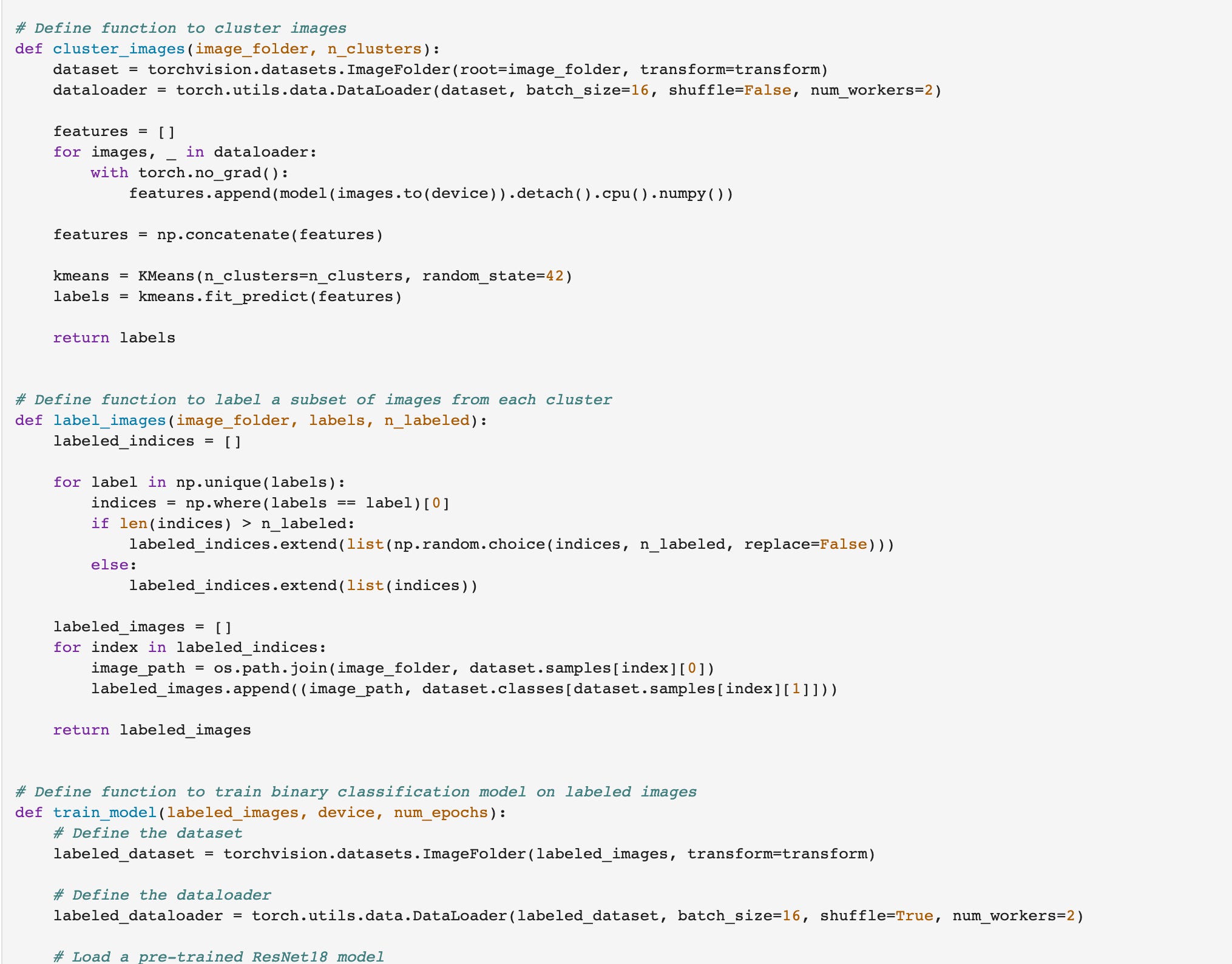
One of the biggest takeaways from this experience has been the importance of collaboration and communication in a start-up environment. With a small team and a tight deadline, it's crucial that everyone is on the same page and working towards the same goal. I've learned to ask for help when I need it and to offer my assistance to others when I can. Working with a small team means that everyone's contributions are vital to achieving the end goal. I have learned the importance of being proactive and transparent in communicating progress and obstacles, as well as actively seeking feedback and suggestions from my colleagues. Through this experience, I have come to appreciate the power of teamwork and how it can drive innovation and problem-solving. Additionally, I have realized that being able to work collaboratively and adapt to different work styles is a valuable skill that will serve me well in my future career endeavours. If you want to check out the baseline model, click the button below 👇
brain tumour classification with transfer learning 🧠
Along with making strides in other aspects of my life this month, I’ve also spent some time to learn and advance in the machine learning field as well. Prior to March, I spent a lot of time making models myself and heavily focusing on UNET and Convolutional Neural Networks. I decided to shift focuses this month and experiment a bit with transfer learning. In simple words, transfer learning is using knowledge that was gained doing one task and applying it to a related one. While experimenting with transfer learning, it became evident that it’s easy to get stuck in one particular technique or approach. Previously, I built models myself and I had a rough framework in my head of how I would go about it, but this time around, that same framework didn’t work. It made it more challenging to implement and pushed me to dig deeper and learn more. Now let’s dive into the more technical aspects of the project.
For this project, I used a dataset from Kaggle that had 4 types of brain tumour images; glioma tumour, meningioma tumour, pituitary tumour and no tumour. If you want to check out the dataset, you can find it here. Here’s a sample of what the images looked like:
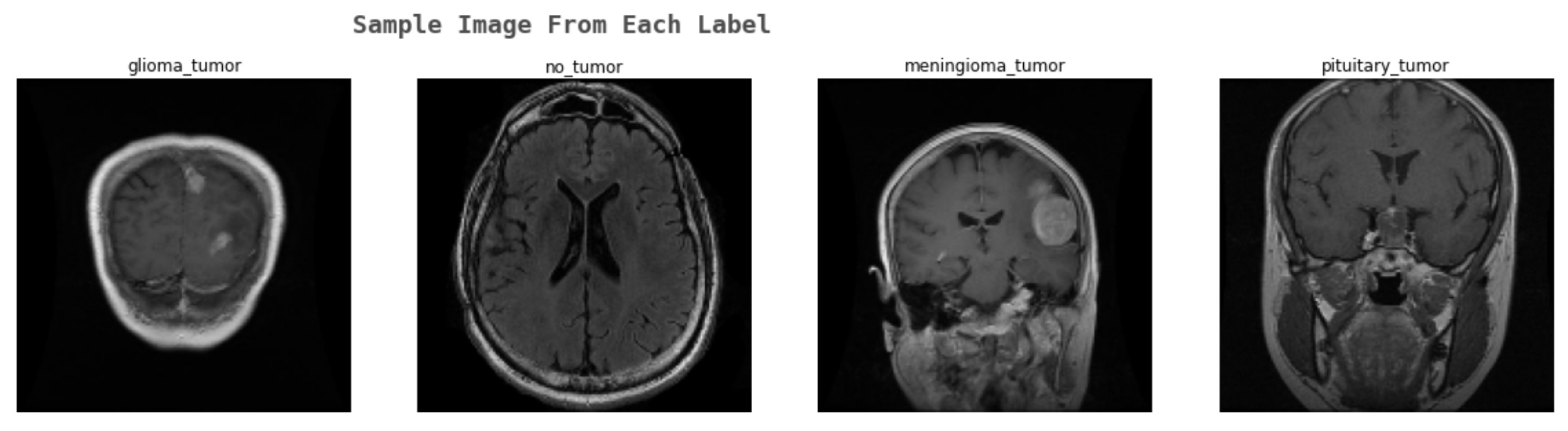
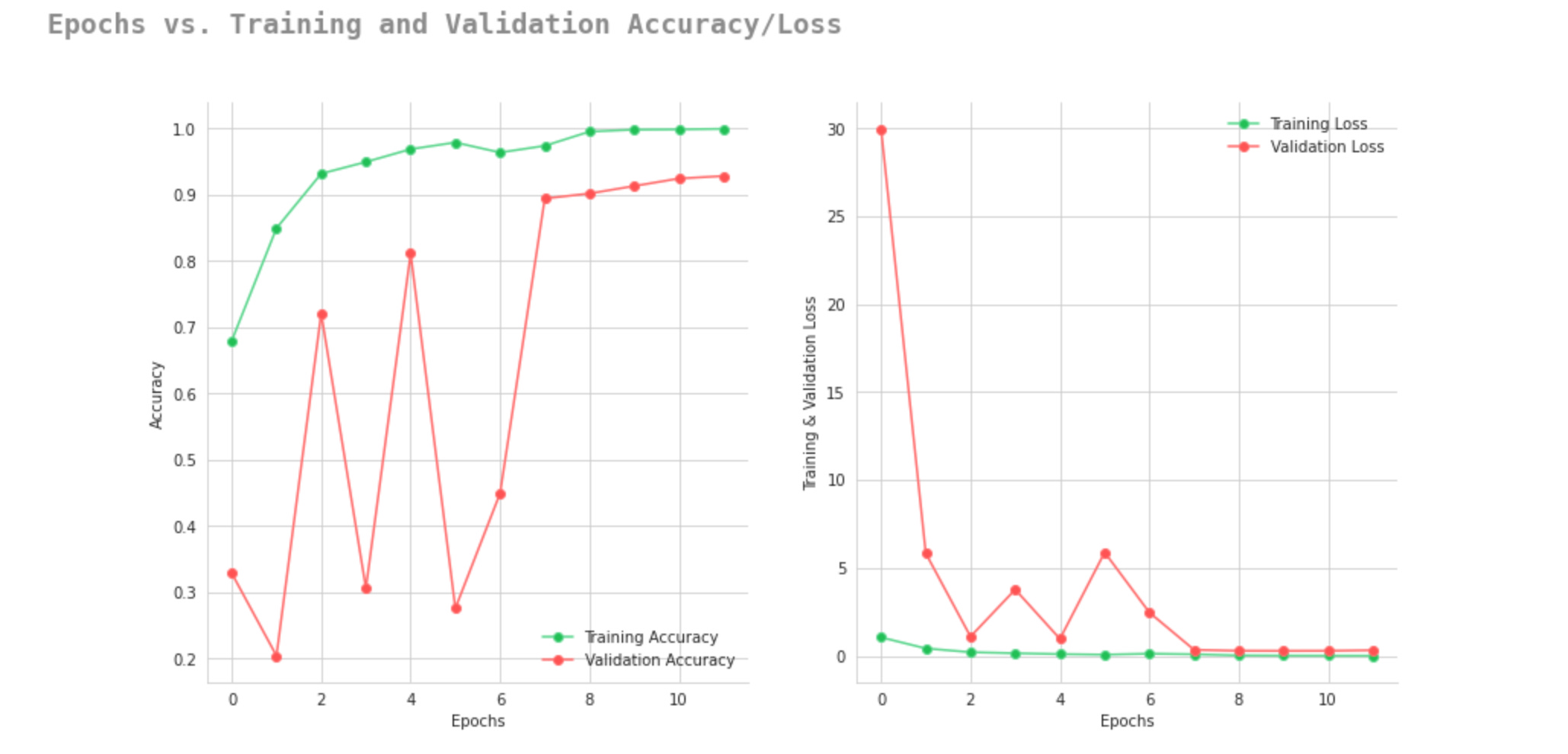
I started the project by doing some data pre-processing and creating arrays for the data. Once that was done, I split the data into 3 sections; training, testing & validating. After playing around with the images using resizing, grey-scale, normalization, batch normalization, etc. I loaded the transfer learning model that I wanted to use. I actually ran into a lot of errors here, I initially tried using the EfficientNet model, but it wasn’t compatible with the new version of TensorFlow and so I went the classic ResNet50 model. The model trained very successfully, the only problem was that it took over 3 hours to train… 😅. After training the model, here are what the results looked like:
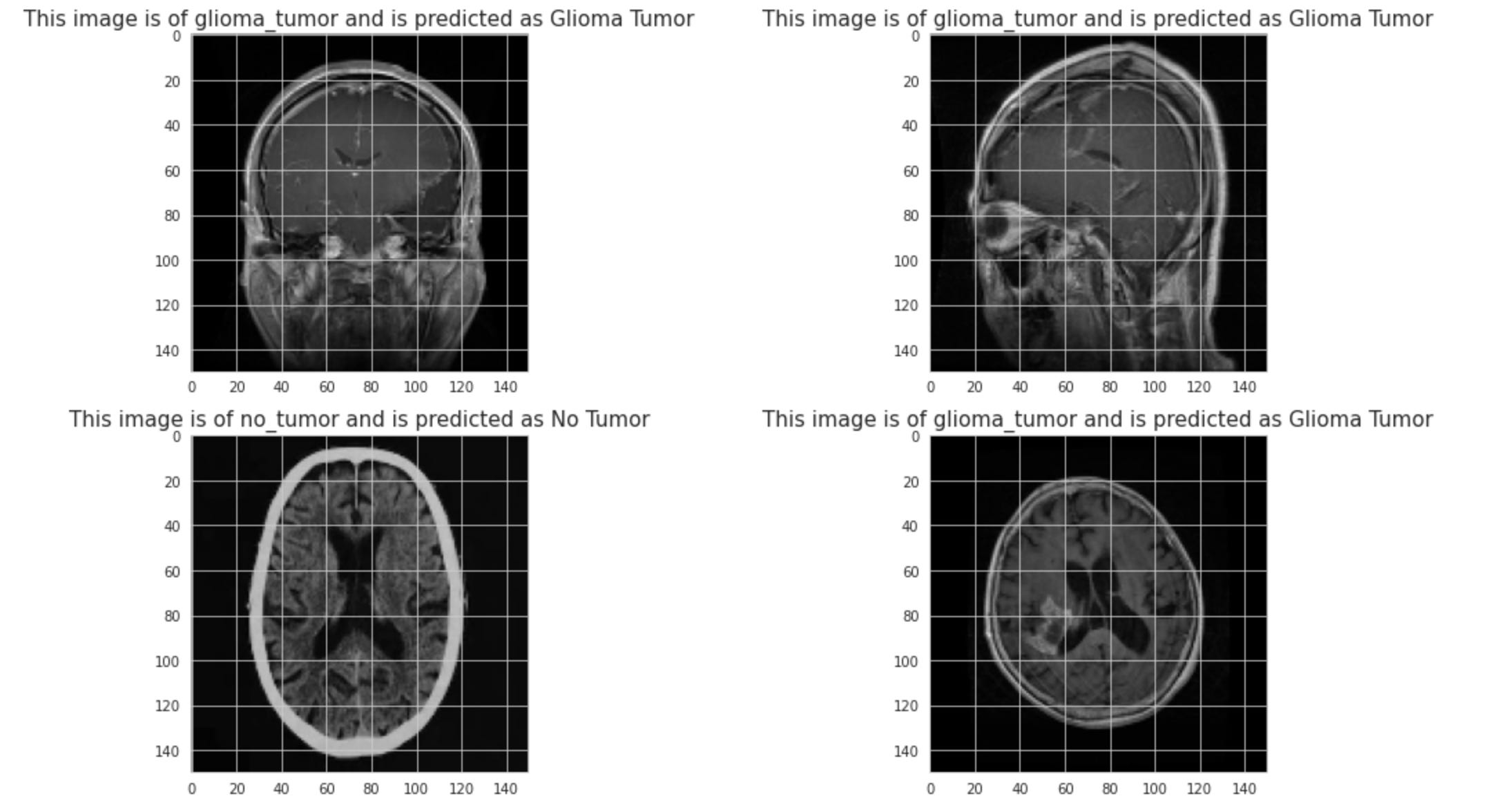
I did some testing as well, here’s what that looked like:
Along with the model, I made a little widget on my Google Colab notebook which would predict the type of tumour based on the image you gave it. I recorded a quick video of it in action and if you want to check it out, click the button below 👇
looking ahead.
If you’ve made it this far, I would like to thank you for taking time to read my newsletter. I hope that my insights and experiences have been valuable to you, and I look forward to sharing more of what I’m up to in the future. With that being said, here’s what I’m going to be working on in the next few months:
Wrapping up my research project at the lab - hoping to build a self-supervision model that works more effectively than transfer learning methods.
Building in the AI space - be on the lookout for bigger + more unique projects to come out in the coming months.
Keeping up with writing - I’m going to continue to consistently put out articles and pieces of writing. Ensuring that I don’t lose my voice in writing.
That’s all from me; if you enjoyed reading this newsletter, please consider subscribing and I’ll see you in the next one 😅.